Performance
remote-store wraps established Python storage libraries. This page presents measured overhead so you can judge whether the abstraction cost matters for your workloads.
Overhead at a Glance
The chart below shows remote-store's overhead (%) versus raw SDK calls for each backend. Negative values mean remote-store is faster than calling the SDK directly (often due to connection pooling and caching).
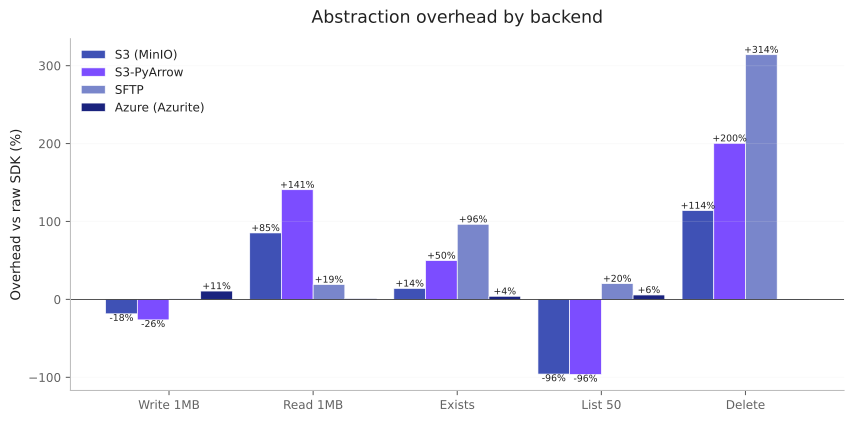
Patterns from Docker benchmarks (MinIO, Azurite, OpenSSH):
- S3: reads and writes add modest overhead over raw boto3; listing is significantly faster via s3fs connection caching.
- S3-PyArrow: reads carry more overhead than the S3 backend (PyArrow C++ data path); writes are comparable. The trade-off is native PyArrow integration — Tier 1 C++ range requests — not raw throughput.
- Azure and SFTP: per-operation overhead is small relative to network round-trip time for most operations.
- Local: all operations are sub-millisecond; overhead versus raw pathlib is measurable but negligible for storage workloads.
Regenerate numbers for your own hardware with hatch run bench-report
(see Running Benchmarks).
What Happens Under Real Latency
Under realistic network round-trip times (20–100 ms), overhead as a percentage shrinks. For example, a 1 ms overhead on a 100 ms round trip is 1%.
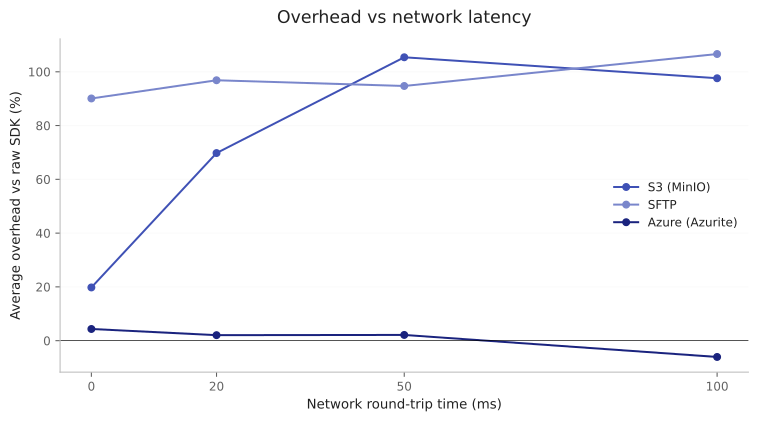
The benchmark suite simulates latency using Toxiproxy with four named profiles:
| Profile | Latency | Jitter | Simulates |
|---|---|---|---|
clean |
0 ms | 0 ms | Baseline (passthrough) |
rtt20 |
20 ms | 7 ms | Same-region cloud |
rtt50 |
50 ms | 17 ms | Cross-region |
rtt100 |
100 ms | 33 ms | Cross-continent |
Throughput by File Size
How throughput scales with file size, comparing remote-store to raw SDK:
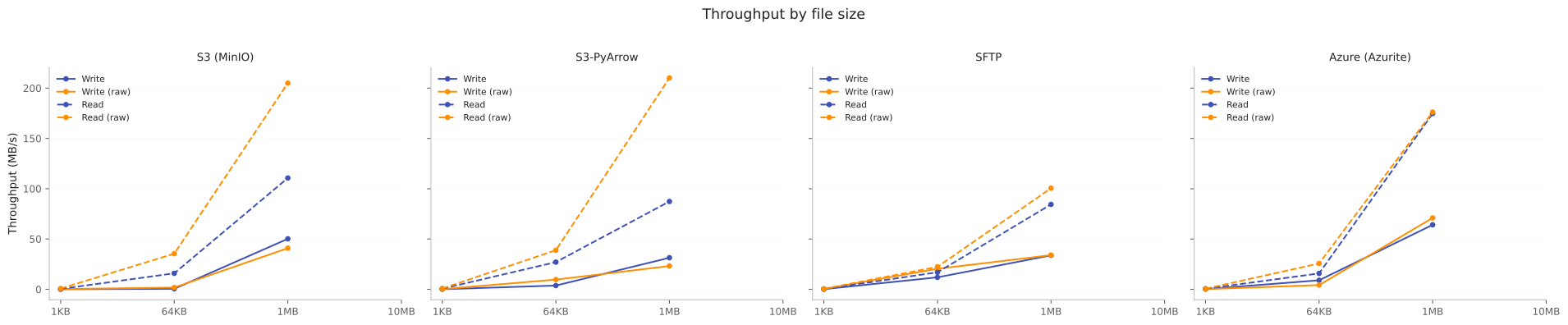
At larger file sizes, throughput converges as the fixed per-operation overhead is amortized across more bytes.
S3 vs S3-PyArrow
Both S3 backends connect to the same service. S3 uses s3fs (Python), S3-PyArrow
uses PyArrow's C++ S3FileSystem for data-path operations. The chart below
compares their absolute latencies:
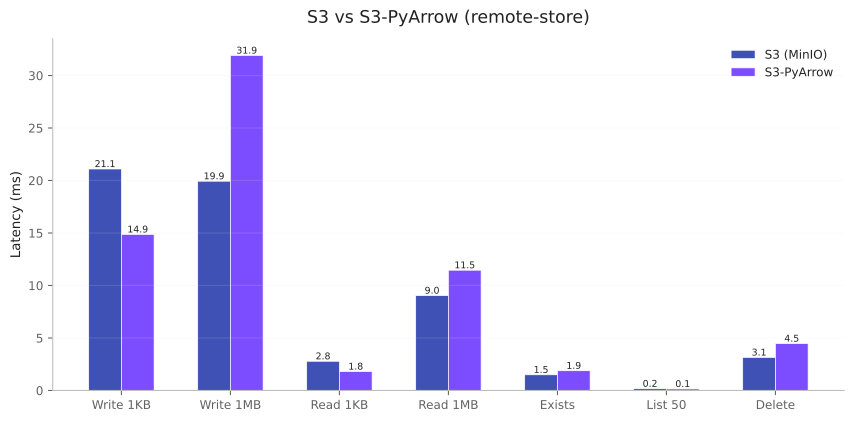
S3-PyArrow reads are slower for sequential workloads because the C++ data path adds connection management and metadata overhead per call. The S3-PyArrow backend's advantage is native PyArrow integration — Tier 1 Parquet column pruning, I/O coalescing, and GIL-free reads. For sequential byte streaming, the regular S3 backend is faster.
Comparative Results
For every operation, the benchmark suite runs the same workload through three interfaces:
- remote-store — the
Backend/StoreAPI - Raw SDK — direct boto3/paramiko/azure-storage-blob/pathlib calls
- fsspec — s3fs/sshfs/adlfs/fsspec.local
Sample Results
Results vary by hardware, network, and service version. Generate numbers for
your environment with hatch run bench-report (summary) or
hatch run bench-report-user (condensed with verdicts).
For a full per-backend comparison of remote-store against the raw SDK and fsspec, see the Detailed Comparative Tables section on the Performance page.
Caveats
- Docker emulators are not cloud. Azurite, MinIO, and the local SFTP container approximate real services but have different performance characteristics. Treat these numbers as relative comparisons, not absolute predictions of cloud performance.
- Listing anomalies. Some fsspec implementations (s3fs, adlfs) show
sub-100us listing times that reflect client-side caching, not real
storage-layer performance.
S3Backenddefaults this directory-listing cache off (fresh listings every call), so those sub-100us numbers appear only when the cache is explicitly re-enabled viaclient_options={"use_listings_cache": True}; with the default, the s3fs path issues a fresh listing like raw boto3. - Delete overhead. 2-3x vs raw SDK across all backends is expected from the error-mapping layer and not an optimization target.
- Streaming reads keep memory constant regardless of file size.
Methodology
Benchmarks use pytest-benchmark with Docker-hosted services (MinIO for S3, Azurite for Azure, OpenSSH for SFTP). Each test runs in an isolated environment — fresh buckets, containers, and directories are created per test fixture and cleaned up after.
| Metric | How | Where |
|---|---|---|
| Throughput (MB/s) | payload_bytes / mean_time | Write, read, roundtrip |
| TTFB (ms) | Time to write/read 1KB file | Protocol overhead |
| Latency (ms) | Mean operation time | Exists, delete, list |
| Memory (MB) | tracemalloc peak | Large-file read/write |
| Listing speed | Time to list N files | 50, 200, 1k, 10k files |
Running Benchmarks
# Start Docker services
docker compose -f infra/docker-compose.yml up -d --wait

# Quick tier (~2 min/backend)
hatch run bench

# Standard tier (~5 min/backend)
hatch run bench-standard

# Full tier (~20-30 min/backend)
hatch run bench-full

# With simulated latency (single profile)
hatch run bench -- --backend s3-latency,sftp-latency,azure-latency --network-profile rtt50

# Latency matrix (runs rtt20, rtt50, rtt100 sequentially, ~8 min/profile)
hatch run bench-latency-matrix

# Save results as JSON
hatch run bench-save

# Reports
hatch run bench-report                    # summary table
hatch run bench-report-user               # condensed with verdicts
hatch run bench-report-comparative        # remote-store vs raw SDK vs fsspec
hatch run bench-charts                    # generate SVG charts

# Stop services
docker compose -f infra/docker-compose.yml down -v
For cloud benchmarks, set the appropriate environment variables (see
benchmarks/README.md for the full reference table) and use --infra cloud.
Detailed Comparative Tables
Per-backend tables comparing remote-store, raw SDK, and fsspec for each
operation. Generated with hatch run bench-report-comparative-md.
Local
| Operation | remote-store | pathlib | fsspec |
|---|---|---|---|
| Write 1MB | 646us | 588us (1.1x faster) | 574us (1.1x faster) |
| Read 1MB | 321us | 249us (1.3x faster) | 259us (1.2x faster) |
| Exists (hit) | 55us | 5us (10.2x faster) | 4us (14.2x faster) |
| List 50 files | 661us | 678us | 143us (4.6x faster) |
| Delete | 112us | 38us (2.9x faster) | 55us (2.0x faster) |
S3 (MinIO)
| Operation | remote-store | boto3 | s3fs |
|---|---|---|---|
| Write 1MB | 19.9ms | 24.5ms (1.2x slower) | 23.8ms (1.2x slower) |
| Read 1MB | 9.0ms | 4.9ms (1.9x faster) | 6.6ms (1.4x faster) |
| Exists (hit) | 1.5ms | 1.3ms (1.1x faster) | 1.3ms (1.1x faster) |
| List 50 files | 168us | 4.0ms (24.1x slower) | 89us (1.9x faster) |
| Delete | 3.1ms | 1.5ms (2.1x faster) | 1.7ms (1.9x faster) |
S3-PyArrow
| Operation | remote-store | boto3 |
|---|---|---|
| Write 1MB | 31.9ms | 43.3ms (1.4x slower) |
| Read 1MB | 11.5ms | 4.8ms (2.4x faster) |
| Exists (hit) | 1.9ms | 1.3ms (1.5x faster) |
| List 50 files | 144us | 4.0ms (27.6x slower) |
| Delete | 4.5ms | 1.5ms (3.0x faster) |
SFTP
| Operation | remote-store | paramiko | sshfs |
|---|---|---|---|
| Write 1MB | 29.6ms | 29.5ms | 14.3ms (2.1x faster) |
| Read 1MB | 11.8ms | 10.0ms (1.2x faster) | 7.2ms (1.6x faster) |
| Exists (hit) | 779us | 397us (2.0x faster) | 652us (1.2x faster) |
| List 50 files | 2.5ms | 2.1ms (1.2x faster) | 3.0ms (1.2x slower) |
| Delete | 1.6ms | 398us (4.1x faster) | 1.2ms (1.4x faster) |
Azure
| Operation | remote-store | azure-blob | adlfs |
|---|---|---|---|
| Write 1MB | 15.6ms | 14.1ms (1.1x faster) | 17.2ms (1.1x slower) |
| Read 1MB | 5.7ms | 5.7ms | 10.2ms (1.8x slower) |
| Exists (hit) | 1.7ms | 1.6ms | 1.9ms (1.1x slower) |
| List 50 files | 9.6ms | 9.1ms (1.1x faster) | 66us (145.3x faster) |
| Delete | 1.8ms | 1.8ms | 4.0ms (2.2x slower) |
See also
- Capabilities Matrix — feature support per backend
- Choosing a Backend — decision guide with trade-offs
- PyArrow Adapter — tiered read strategy and S3 direct I/O